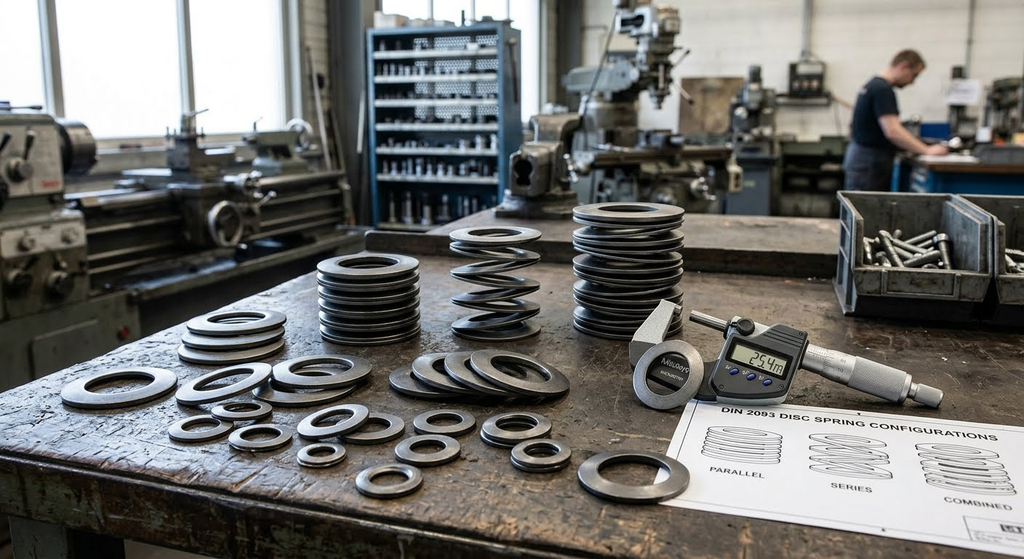
Step into the world of DIN 2093 Disc Springs
DIN 2093 (harmonized globally as DIN EN 16983) is the industrial engineering standard for dimensioning and manufacturing disc springs (Belleville washers).
The standard categorizes these washers using two different classification methods: Dimensional Series (which determines the force characteristics) and Manufacturing Groups (which defines how they are constructed based on thickness).
1. The Three Dimensional Series (A, B, and C)
The standard defines three distinct series based on the ratio of the spring’s cone height (h₀) to its wall thickness (t). This ratio dictates how “stiff” or “heavy” the spring behavior is:
| Series | Type Description | Deflection / Force Profile | Typical Application |
|---|---|---|---|
| Series A | Heavy / High Force | Very thick relative to its cone height. Yields a massive spring force with short deflection stroke. | Safety torque limiter clutches, heavy assemblies, high bolt preloading. |
| Series B | Medium Force | Balanced thickness and height. Provides standard, predictable linear-to-degressive load curves. | General industrial machinery, valve actuators, and automotive clutch plates. |
| Series C | Light / Low Force | Thin relative to its height. Highly flexible with long deflection curves and significantly lower forces. | Play compensation, anti-vibration damping, and circuit breakers. |
2. The Three Manufacturing Groups
DIN 2093 also breaks the washers into groups based entirely on material thickness (t) to regulate precision tolerances, manufacturing methods, and contact surfaces:
- Group 1 (Thickness < 1.25 mm): Cold-formed (stamped) from carbon steel sheets or strips. They feature radiused edges and have no bearing flats.
- Group 2 (Thickness 1.25 mm to 6.0 mm): Cold-formed, then machined or fine-blanked. They feature radiused edges on the inside/outside and also lack contact flats.
- Group 3 (Thickness > 6.0 mm up to 14.0 mm): Fully machined from forged blanks. Because of their immense thickness, they are manufactured with bearing flats (ground flat contact zones on the top inside edge and bottom outside edge). The standard requires a slightly reduced material thickness (t’) for this group to compensate for the stiffness added by the flats.